Abu Abdullab Al-Maziri said, "Plethoric (excessive substances) conditions are either sanguineous (bloody), bilious (phlegm), or melancholic, and curing sanguineous plethora entails extracting the blood. If plethora was from the other three types, its cure is in softening the stool as warranted for each disease. Prophet Muhammad Sallallaho Alaihe Wasallam has indicated that honey is used as a laxative and that cupping is used to extract [septic] blood. Some people said that when the slash by a cupping knife does not work, the last resort is branding by fire (cauterizing). Prophet Muhammad Sallallaho Alaihe Wasallam mentioned branding by fire as a last resort when the body has a strong resistance against medicine, rendering it ineffective. Our beloved Prophet then said: "I forbid my Ummah (Muslim Nation) from branding by fire (cauterizing)", and in another narration, "I do not like to be branded by fire". Cauterizing by fire should be the last resort and only used when warranted. The fire should not be the first choice because of the intense pain it causes, which can be more severe than the pain with which a patient is already suffering.
Some doctors said that diseases related to the temperament are either material or non-material. The material types are either cold, hot, wet or dry or a combination of these conditions. The four conditions, hotness and coldness are effected; while the other two, wetness and dryness are usually affected When one of the two effective temperaments is stronger than the other, one of the affected temperaments usually accompanies it. Every type of temperament in the body has two parts, effective and affected.
Temperamental ailments are usually caused by whichever effective condition is stronger, hotness or coldness. Our beloved Prophet’s statement directs us to the origin of ailments, hotness and coldness. If the ailment was hot, the cure entails extracting the blood by cupping or puncturing the veins, both of which help extract the septic matter, cooling the temperament. If the ailment is cold, we treat it with heat, such as by taking honey. If we need to extract the cold material that has caused the ailment, honey helps in this case because it leads the various substances to maturity along with its other qualities of cleansing, softening, soothing and purging the affected organs. In this case, the septic material will be gently extracted while saving the body from the abuse of using strong laxatives.
Physical ailments are either acute, not needing cauterization, because they would soon be neutralized, or chronic ailments, for which cauterizing the proper organ is the best remedy after extracting the septic substances. Chronic diseases usually result from thick, cold septic substances residing in the affected organ, ailing it, spoiling its constitution and, thereby, inflaming the parts of the body that are directly connected to the affected organ. Therefore, cauterizing should be used to dissipate and extract the septic substances in the affected organ with fire.
The Hadith explains treatments for all type of physical ailments, just as we learned the treatment method for all simple ailments (accompanied by fever) from the Hadith,
"إنَّ شدةَ الحُمَّى مِن فَيْحِ جَهَنَّمَ، فأبرِدُوهَا بالماء"
"The heat of the fever is a breath of the Hell Fire; cool it with water".
More Narrations on Hijamah
وفى "الصحيحين" من حديث طَاووس، عن ابن عباس، أنَّ النبىَّ صلى الله عليه وسلم "احتجَمَ وأعْطى الحَجَّامَ أجْرَه"
In addition, in the Sahihain, it is narrated that Prophet Muhammad Sallallaho Alaihe Wasallam once had his blood cupped (medically) and paid the person who applied the Hijamah (cupping).
Furthermore, in the Sahihain it is narrated:
وفى "الصحيحين" أيضاً، عن حُمَيدٍ الطويل، عن أنس، أنَّ رسول الله صلى الله عليه وسلم حجمَهُ أبُو طَيْبَةَ، فأمَرَ لهُ بصَاعينِ مِن طعامٍ، وكلَّمَ مواليهُ، فخفَّفُوا عنهُ مِن ضريبتِهِ، وقال: "خَيْرُ مَا تَدَاويْتمْ بِهِ الْحِجَامَةَ".
Abu Taybah cupped Allah’s Messenger, who then ordered that Abu Taybah be paid one Sa’a (a measure pertaining to food) of dates and ordered his masters to reduce his tax (as he was a slave and had to pay a tax to them). Prophet Muhammad Sallallaho Alaihe Wasallam then said:
"Hijamah (Cupping) is among your best remedies".
وفى "جامع الترمذىّ" عن عبَّاد بن منصور، قال: سمِعتُ عِكْرمَةَ يقولُ: "كانَ لابن عباسٍ غِلمةٌ ثلاثةٌ حَجَّامُون، فكانَ اثنَانِ يُغلانِ عليه، وَعَلَى أهلِهِ، وواحدٌ لحجمِهِ، وحجمِ أهلِهِ. قال: وقال ابنُ عباسٍ: قال نبىُّ الله صلى الله عليه وسلم: "نِعْمَ العبدُ الحَجَّامُ يَذْهَبُ بالدَّمِ، وَيُخِفُّ الصُّلْبَ، ويَجْلُو البَصَرَ".
In Tirmizi, it is narrated by Abbaad Bin Mansoor that he said: I heard Ikramah saying that Abdullah Ibn Abbas Radi Allaho Anh had three slaves who were Hajjaam (a person who performs cupping), two of them used to work for him & his family (probably at his garden & to carry the grains & load to his house) & one of those slaves performed cupping. Abdullah Ibn Abbas Radi Allaho Anh reported that Prophet Muhammad Sallallaho Alaihe Wasallam said : "The best of slaves is HAJJAAM (one who performs Hijamah ~ wet cupping), Hijamah takes out the blood, & removes the pain from the back & enhances the vision".
وقالَ: "إنَّ خيرَ مَا تحْتَجِمُونَ فيهِ يَوْمَ سَبْعَ عَشْرَةَ، ويَوْمَ تِسْعَ عَشْرَةَ، وَيَوْمَ إحْدَى وَعِشرينَ"، وقال: "إنَّ خَيْرَ ما تَدَاويْتُمْ بِهِ السَّعُوطُ واللَّدُودُ والحِجَامَةُ والمَشِىُّ
Prophet Muhammad Sallallaho Alaihe Wasallam said "The best dates for Hijamah are 17th, 19th & 21st of the lunar month" and he also said "The best among your treatments is Sa'oot (taking medicine through the nose), Ladood (taking medicine by mouth), Hijamah (Wet Cupping) & Mashee (cleaning the stomach).
The benefits of cupping include cleansing the exterior parts of the body more than puncturing the veins, or puncturing the veins, is better when used to extract blood from the internal parts of the body. Cupping entails removing blood from the various parts of the skin.
Using either Hijamah (cupping) or Fasd (puncturing the veins) depends on the time of year, the area, the age and state of the ailing person. For instance, cupping is more beneficial than puncturing the veins in warm areas, warm weather and hot tempered people, whose blood is near to maturity (concerning the septic substances in the blood). In this case, the septic, maturing blood will collect near the skin. Cupping extracts the septic blood more efficiently than puncturing the veins. This is why using cupping for children and those who cannot bear puncturing the veins is better and more useful.
Doctors affirm that Hijamah (cupping) is better used in warm areas than puncturing the veins and that cupping is preferred in the middle of the month or soon after, especially in the last quarter of the month. In the beginning of the month, the blood will have already become irritated (thus carrying septic materials that need to be cupped). In the end of the month, the blood will be idle, unlike the case in the middle and last quarter of the month when the blood is agitated and sufficiently produced.
The author of Al-Qanoon said; Cupping is not preferred in the beginning of the month, because the body’s various conditions will not be agitated then, nor is it preferred in the end of the month, because by then the conditions would have decreased. Cupping is preferred in the middle of the month when the substances (of the constitution or condition) accumulate and become agitated. It was reported that the Prophet Muhammad Sallallaho Alaihe Wasallam said:
"خَيْرُ ما تداويتم به الحِجَامَة والفَصْدُ
"Cupping and puncturing the veins are your best remedies".
This Hadith is directed at the people of Hijaaz and warm areas in general, for their blood is delicate and circulates closer to the surface of the skin, while the pores on their skin are wide and their strength is weakened (i.e., during summer). Puncturing the veins is harmful for them. Puncturing of each of the veins usually has a special benefit. For instance, puncturing of the basilica vein (the large vein running on the inner side of the upper arm) is useful against the heat of the liver and spleen and various blood-related tumors in these two organs. It is in addition useful for tumors of the lungs (emphysema), arterial pulsation, pleurisy and all blood-related diseases of veins in the lower part of the knee to the hip. Furthermore, puncturing of the median vein helps against the various swellings that appear throughout the entire body, especially when the swelling is blood-related, and contains spoiled blood in general. In addition, puncturing of the arm’s vein helps against the ailments in the head and neck that result from excessive amounts of blood or from septic blood. Puncturing of the jugular vein helps against the ailments of the spleen, asthma, thoracic cavity and forehead pain.
More Detail On When Cupping Is preferred
روى الترمذى فى "جامعه" من حديث ابن عباس يرفعه: "إنَّ خَيْرَ ما تَحتَجِمُون فيه يَوْمُ سابعَ عشَرَةَ، أو تاسِعَ عشرةَ، ويومُ إحْدَى وعِشْرِينَ".
Anas Radi Allaho Anh related from Prophet Muhammad Sallallaho Alaihe Wasallam that he said:
"The Messenger of Allah used to have cupping on the jugular veins and the upper part of the back on the seventeenth, nineteenth or twenty-first (day of the month)". (Al Tirmizi)
Anas Radi Allaho related from Prophet Muhammad Sallallaho Alaihe Wasallam that he said:
وفى "سنن ابن ماجه" عن أنس مرفوعاً: "مَنْ أراد الحِجَامة فَلْيَتَحَرَّ سَبْعَةَ عَشَرَ، أو تِسْعَةَ عَشَرَ، أو إحْدَى وعِشرِينَ، لا يَتَبَيَّغ بأحَدِكُم الدَّمُ، فيقتلَه".
"Those who intend to have cupping; let them do that on the seventeenth, nineteenth or twenty first (of the month); to prevent the septic blood from causing death to one of you". (lbn Majah)
In addition, Abu Dawood narrated that Abu Hurayrah Radi Allaho Anh related from Prophet Muhammad Sallallaho Alaihe Wasallam that he said:
وفى "سنن أبى داود" مِن حديث أبى هريرة مرفوعاً: "مَن احْتَجَمَ لِسَبْع عَشْرَةَ، أو تِسْعَ عَشْرَة، أو إحْدَى وعِشْرِينَ، كانَتْ شِفاءً من كلِّ داءٍ"،
"Those who have cupping on the seventeenth, nineteenth or twenty first will be cured from every disease". (Every disease mentioned in the Hadith means the blood-related diseases).
Both of the last two Ahadeeth are weak.
These Ahadeeth conform to the position taken by doctors that cupping is preferred in the latter half of the month and (he third quarter, rather than the beginning or the end of the month. However; if Hijamah is necessary, it will be useful during any part of the month including the beginning and the end. It was reported that Imam Ahmad lbn Hanbal used to practice Hijamah (cupping) during any part of the month when the spoiled blood became agitated.
The author of Al-Qanoon said, "Hijamah / Wet Cupping is preferred during the day, the second or the third hour and after one takes a bath, when warranted, one should take a bath then rest for an hour or so and then use cupping". Cupping is not preferred when the stomach is full, for it might cause various ailments, especially after taking a heavy meal.
It was said that cupping on an empty stomach is a cure, and when ones stomach is full is a disease, and when it is done on the seventeenth of the month, it becomes a remedy. Choosing the best time for cupping preserves good health and helps prevent harm from attacking the body. However, when the illness intensifies, cupping becomes warranted and needed whatever the circumstances, for our beloved Prophet said:
"لا يَتَبَيَّغْ بأحدِكم الدَّمُ فيقتلَهُ"،
"Be aware, so that the septic blood does not cause death to one of you".
We stated before that Imam Ahmad used to take Hijamah during any time of the month if cupping was medically warranted.
As for the best days of the week to have cupping, Al-Khalil said that Imam Ahmad was asked about the days when cupping is not preferred, and he said, "Wednesday and Saturday". In addition, Al-Khalil narrated that Imam Ahmad was once asked about the days when cupping is disliked and Imam Ahmad answered, "Saturday and Wednesday", and in addition Friday was also reported
However, all the Ahadeeth that state the time when the cupping is either preferred or disliked are weak, according to the scholars of Hadith.
The previous Ahadeeth we mentioned state that seeking the cure by Hijamah instead of Fasd is preferred. In addition, cupping is done in the part of the body that needs it the most. Those who have Ihram (during Hajj or Umrah) are allowed to use cupping, even if it involves cutting some hair and they do not have to pay a penalty. Further, it is allowed for those who are fasting to use cupping as Bukhari narrated that the Messenger of Allah took Hijamah while he was fasting.
There are several Ahadeeth that state that Hijamah breaks the Fast. The only Hadith that appears to contradict this ruling is the Hadith that Prophet Muhammad Sallallaho Alaihe Wasallam had cupping while fasting. In this case, for the Hadith to mean that cupping does not break the Fast, it should satisfy one of the following four conditions:
First, Fasting should have been obligated by the time the incident in the Hadith [narrated by Al-Khalil above] occurred. Second, it should be proven that Prophet Muhammad Sallallaho Alaihe Wasallam was not traveling [when he had cupping]. Third, that our beloved Prophet was not suffering from an illness that warranted cupping. Fourth; that this Hadith came after our beloved Prophet said,
"أفطَرَ الحاجِمُ والمحجُومُ".
"Those having cupping and those who do it have both broken their fast".
If these four conditions are satisfied, only then we can say that cupping does not break the fast, relying on the Hadith that Prophet Muhammad Sallallaho Alaihe wasallam took Hijamah when he was fasting. Otherwise, the Fast mentioned in the Hadith might have been a voluntary fast that too is allowed to break when cupping is warranted. Or it could have occurred during Ramadan but while the Prophet was traveling. Or the Hadith might be talking about a compulsory Fast during Ramadan but that it was necessary to have cupping due to an illness. Or, cupping could dove been done during Ramadan and without a necessity that warrants it, but before our beloved Prophet issued his statement that cupping breaks the Fast of those involved in it. There is no proof that any of the four conditions we mentioned above wore satisfied, so how about all four of them?
In addition, the Hadith proves that one is allowed to hire a doctor for a certain purpose and then pay him for his services without a service contract.
The Hadith (that our beloved Prophet paid the person who performed cupping for him) indicates that some people are allowed to make Hijamah (wet cupping) their profession. Prophet Muhammad Sallallaho Alaihe Wasallam gave the man who performed cupping some money and that person spent that money on his necessities.
Finally, the Hadith proves that one is allowed to collect reasonable taxes from his slave and that the slave is allowed to use whatever is left after paying the tax. Otherwise, if the master is going to take all the money anyway, it will not be called a tax any more. Therefore, whatever is left with the slave beyond the required tax is his property and he can do whatever he wishes with it.
More Detail On Hijama For Treating Shir
Some people have erroneously denied that SEHR ~ sorcery (magic) could affect Prophet Muhammad Sallallaho Alaihe Wasallam; they believed that it was not befitting his grade and status. Actually, being effected by SEHR ~ sorcery illustrates the human side of the Prophet, just like he suffered from various other illnesses, and sorcery is an ailment just like poison.
وقد ثبت فى "الصحيحين" عن عائشة رضى الله عنها، أنها قالت: "سُحِرَ رسولُ الله صلى الله عليه وسلم حتى إنْ كان لَيُخَيَّلُ إليه أنه يأتى نِساءه، ولم يَأتِهِنَّ"، وذلك أشدُّ ما يكون مِن السِّحر
In the Sahihain, it is narrated that Aishah Radi Allaho Anha said:
"The Messenger of Allah Sallallaho Alaihe Wasallam was affected by SEHR ~ sorcery until he thought that he had slept with his wives, while in fact he did not".
This is the worst type of magical spell.
Qazi Eyadh said, SEHR ~ sorcery is just like any other ailment that our beloved Prophet had suffered from, and this fact by no means affects his status as a Prophet. Furthermore, the fact that Prophet Muhammad Sallallaho Alaihe Wasallam had imagined something which he did not perform, does not detract from his truthfulness regarding religion; there is a consensus that he is immune from error in this regard. SEHR ~ sorcery is just like any other matter of this life, which has nothing to do with the reason why he was sent and preferred above mankind. Prophet Muhammad Sallallaho Alaihe Wasallam was subject to come down with all types of ailments that would touch other people. Therefore, it is not surprising that he would imagine doing something which in fact he did not do, and that he was soon cured.
Prophet Muhammad Sallallaho Alaihe Wasallam used two methods to treat sorcery, first by finding the spell and neutralizing it. Prophet Muhammad Sallallaho Alaihe Wasallam supplicated to his Lord and Allah Showed him that the evil spell was hidden in a well. Prophet Muhammad Sallallaho Alaihe Wasallam removed the evil spell, which consisted of a comb, combed material (hair) and a dry male spathe. When he discarded these objects, he was immediately cured, as if he was restrained and then suddenly released. This is the best cure from sorcery and is similar to removing septic materials by complete disgorging.
The second type, extracting harmful substances from the organ is most touched by magic works. Evil spells aggravate nature, produce harmful substances and adversely affect the mood. Disgorging the alien substance (that affected a certain organ as a result of evil spells) becomes necessary.
Abu Ubaid has mentioned in his book, on the authority of Abdul Rahman Bin Abi Layla that Prophet Muhammad Sallalllaho Alaihe Wasallam had HIJAMAH performed on his head by a thorn when he was affected by Tubb, & Abu Ubaid says that Tubb means magic.
The effect of Sehr ~ sorcery reached our beloved Prophet's head and affected one of his senses; he imagined he did something while in fact he had not. The sorcerer, therefore, affects some of the natural powers of the body so that it does not function normally.
SEHR ~ sorcery is a combination of the powers of evil spirits and the adverse effects they have on the normal functions of the body. The worst type of magic is that which affects the senses of the affected organ. Drawing blood from the organ most affected by magic is the most beneficial cure, if used in the proper manner.
Some people also said that when Prophet Muhammad Sallallaho Alaihe Wasallam suffered from this condition, he first thought that it was caused by spoiled blood that reached the brain and affected the senses. In such cases, HJAMAH ~ cupping is the best medicine, and this is what Prophet Sallallaho Alaihe Wasallam did. Then, when Allah Revealed to him that it was the effect of magic that caused his condition, he asked Allah to Show him where the evil spell was hidden; and then he retrieved and discarded it. When he did so, he was cured as if released after being restrained. Further, the magic spell only affected our beloved Prophet’s senses; not his sanity or heart. This is why he did not believe what he imagined of sleeping with his wives because he knew that this sensation was not real.
Divine cures are the best remedies against SEHR ~ sorcery. Since sorcery is the work of evil spirits, then its best cure is that which neutralizes it, such as certain prayers and recitations of the Quran. The more powerful the defending army is, the more powerful the adversary it will be able to remove and neutralize. This case is similar to two opposing armies, each of which carries its own weapons and armaments. Army that has more weapons and supplies; is the army that will prevail in the war. When the heart is full of Allah’s remembrance and invokes Him often for its needs, and when the heart is joined by the tongue and righteous deeds, these acts will be the best medicine available against sorcery and magic spells. The sorcerers and magicians admit that their magic is most effective against those who have weak hearts that are busy satisfying the desires and lusts of the life of this world. That is why magic usually affects women, children, nomads, ignorant people, those who have weak Faith, lack trust in Allah (Tawakkul) and lack the fundamentals of oneness of Allah (Taauheed), and those who neither remember Allah often nor use the various Prophetic supplications and Islamic prayer formulas (Ruqyah). In general, the effect of sorcery and magic is more powerful against weak hearts that lean towards the lower desires of this world.
When the heart leans towards this earthly life, sorcery and magic become most effective against it, because evil spirits only search for evil in the soul that is prone to submit to their power. Surely, evil in the heart deprives one of divine power that is necessary to provide it with sufficient weapons of defense against these evil spirits. That is why these evil spirits, which seek evil, find the hearts weakened by evil unarmed and prone to submit to evil and this is when sorcery and magic spells are most effective. And Allah Knows the best.
More Detail On Hijamah ~ Antidote for Poison
ذكر عبد الرزَّاق، عن معمر، عن الزُّهْرىِّ، عن عبد الرحمن بن كعب ابن مالك: أنَّ امرأةً يهوديةً أهدَتْ إلى النبىِّ صلى الله عليه وسلم شاةً مَصْلِيَّةً بِخَيْبَر، فقال: "ما هذه" ؟ قالتْ: هَديَّةٌ، وحَذِرَتْ أن تقولَ: مِنَ الصَّدَقة، فلا يأكلُ منها، فأكل النبِىُّ صلى الله عليه وسلم، وأكل الصحابةُ، ثُم قال: "أمسِكُوا"، ثم قال للمرأة: "هل سَمَمْتِ هذه الشَّاة" ؟ قالتْ: مَن أخبَرَك بهذا ؟ قال: "هذا العظمُ لساقها"، وهو فى يده، قالتْ: نعمْ. قال: "لِمَ" ؟ قالتْ: أردتُ إن كنتَ كاذباً أن يَستريحَ منك النَّاسُ، وإن كنتَ نبيّاً لم يَضرَّك، قال: فاحتَجَم النبىُّ صلى الله عليه وسلم ثلاثةً على الكاهِلِ، وأمَرَ أصحابَه أن يَحتجِمُوا؛ فاحتَجَموا، فمات بعضُهم.
Abdul Razzaq narrated that, “A Jewish woman brought to Prophet Muhammad Sallallaho Alaihe Wasallam a roasted sheep that she had poisoned, while he was in Khyber. Our beloved Prophet asked, ‘What is this, She said, a gift, being careful not to say that it was from charity so that he would not eat it. Prophet Muhammad Sallallaho Alaihe Wasallam and Sahabah (his companions) ate from the sheep, then our beloved Prophet said, "Stop eating". He said to the woman, ‘Did you poison this sheep?’ She said, "Who told you that" ? He said, this bone,’ meaning the ewe’s leg that he had in his hand. She said, "Yes". He said, ‘Why?’ She said, I thought that if you were a liar, the people would be relieved from you. However, if you were a true Prophet, it would not harm you.’ Prophet Muhammad Sallallaho Alaihe Wasallam then used HIJAMAH (cupping) thrice on the KAHIL (upper part of his back) and commanded that his Companions do the same. Yet, several of them died.”
وفى طريق أُخرى: "واحتَجَمَ رسولُ الله صلى الله عليه وسلم على كاهِلِه مِنْ أجْل الذى أكَلَ من الشَّاة، حَجَمَه أبو هِندٍ بالقَرْنِ والشَّفْرة، وهو مولىً لبنى بَيَاضَةَ من الأنصار، وبقى بعد ذلك ثلاثَ سنين حتى كان وجعُه الذى تُوفى فيه، فقال: "ما زِلْتُ أجِدُ من الأُكْلَةِ التى أكَلْتُ مِن الشَّاةِ يومَ خَيْبَرَ حتى كان هذا أوانَ انْقِطَاعِ الأَبْهَرِ مِنِّى"، فتُوفى رسول الله صلى الله عليه وسلم شهيداً
In another narration reported by Musa bin Uqbah, “The Messenger of Allah (Sallallaho Alaihe Wasallam) used HIJAMAH (cupping) on his back because of what he ate of the poisoned sheep. Abu Hind, a servant for Bani Bayadhah (from Ansaar), used a knife to cup him. Three years later, when the Prophet was suffering from the illness that he died from, he said: "I still feel the effects of the poisoned sheep I ate from during the Day of Khyber until now, when it is the time the aorta is cut off (meaning when death is near)’. Therefore the Messenger of Allah (Sallallaho Alaihe Wasallam) died as a martyr.
Poisons are treated by extracting them out and by using the proper antidotes to neutralize their effect. Whoever does not have access to the medicine, or the antidote should use complete disgorging, the best method of which is HIJAMAH (cupping) especially in warm areas and during the hot weather. The poison passes through the veins and the blood vessels to the heart and then to the rest of the body, bringing certain death. Since the blood is the means that transports the poison to the heart and organs, when the infected blood is extracted by Hijamah, the body will get rid of the poison. In addition, when one resorts to complete disgorging, the poison does not cause any further harm, the body gets enough strength to fight it & then weakens or even completely dissipates the poison.
When Prophet Muhammad Sallallaho Alaihe Wasallam used cupping, he did it in the upper part of the back, which is the most direct route to the head & heart, and so the poison was extracted with the blood, in this case only partially. A part of the poison remained in our beloved Prophet's body, in order to fulfill what Allah Had Decided for His Prophet; so he would acquire every type of good and righteous reward.
When Allah Decided that it was time for His Prophet to die as a martyr, the effect of the poison reappeared, so that Allah's Decision was Fulfilled. Therefore, the meaning of the following Ayah becomes apparent where Allah says,
أَفَكُلَّمَا جَاءَكُمْ رَسُولٌ بِمَا لاَ تَهْوَى أَنفُسُكُمُ اسْتَكْبَرْتُمْ فَفَرِيقاً كَذَّبْتُمْ وَفَرِيقاً تَقْتُلُونَ
It is that whenever there came to you a Messenger with what you (yourselves) desired not, you grew arrogant? Some you disbelieved and some you killed. (2:87)
This Ayah uses the word "disbelieve" in the past tense and the word "kill" in the future tense, indicating an uncompleted action that would continue to occur; meaning the Jews would kill the Prophet & Allah Knows the best.
More Detail On Hijamah Points in HADITH
Here you can find the reference from Hadith for Hijamah points of Prophet Muhammad Sallallaho Alaihe Wasallam.
Prophet Muhammad Sallallaho Alaihe Wasallam also took Hijamah on the hip & top of his foot, which explains that Hijamah at the painful area is also recommended by Tibb-e-Nabawi.
In Ghazwah Khyber while our beloved Prophet was poisoned, he took Hijamah at 3 points on the KAHIL, we feel that a cup was applied behind the heart (at the left of KAHIL), & the third was either a little bit lower to this point OR on the right side of KAHIL, Allah Knows the best.
ذكر عبد الرزَّاق، عن معمر، عن الزُّهْرىِّ، عن عبد الرحمن بن كعب ابن مالك: أنَّ امرأةً يهوديةً أهدَتْ إلى النبىِّ صلى الله عليه وسلم شاةً مَصْلِيَّةً بِخَيْبَر، فقال: "ما هذه" ؟ قالتْ: هَديَّةٌ، وحَذِرَتْ أن تقولَ: مِنَ الصَّدَقة، فلا يأكلُ منها، فأكل النبِىُّ صلى الله عليه وسلم، وأكل الصحابةُ، ثُم قال: "أمسِكُوا"، ثم قال للمرأة: "هل سَمَمْتِ هذه الشَّاة" ؟ قالتْ: مَن أخبَرَك بهذا ؟ قال: "هذا العظمُ لساقها"، وهو فى يده، قالتْ: نعمْ. قال: "لِمَ" ؟ قالتْ: أردتُ إن كنتَ كاذباً أن يَستريحَ منك النَّاسُ، وإن كنتَ نبيّاً لم يَضرَّك، قال: فاحتَجَم النبىُّ صلى الله عليه وسلم ثلاثةً على الكاهِلِ، وأمَرَ أصحابَه أن يَحتجِمُوا؛ فاحتَجَموا، فمات بعضُهم.
Abdul Razzaq narrated that, “A Jewish woman brought to Prophet Muhammad Sallallaho Alaihe Wasallam a roasted sheep that she had poisoned, while he was in Khyber. Our beloved Prophet asked, ‘What is this, She said, a gift, being careful not to say that it was from charity so that he would not eat it. Prophet Muhammad Sallallaho Alaihe Wasallam and Sahabah (his companions) ate from the sheep, then our beloved Prophet said, "Stop eating". He said to the woman, ‘Did you poison this sheep?’ She said, "Who told you that" ? He said, this bone,’ meaning the ewe’s leg that he had in his hand. She said, "Yes". He said, ‘Why?’ She said, I thought that if you were a liar, the people would be relieved from you. However, if you were a true Prophet, it would not harm you.’ Prophet Muhammad Sallallaho Alaihe Wasallam then used HIJAMAH (cupping) thrice on the KAHIL (upper part of his back) and commanded that his Companions do the same. Yet, several of them died.”
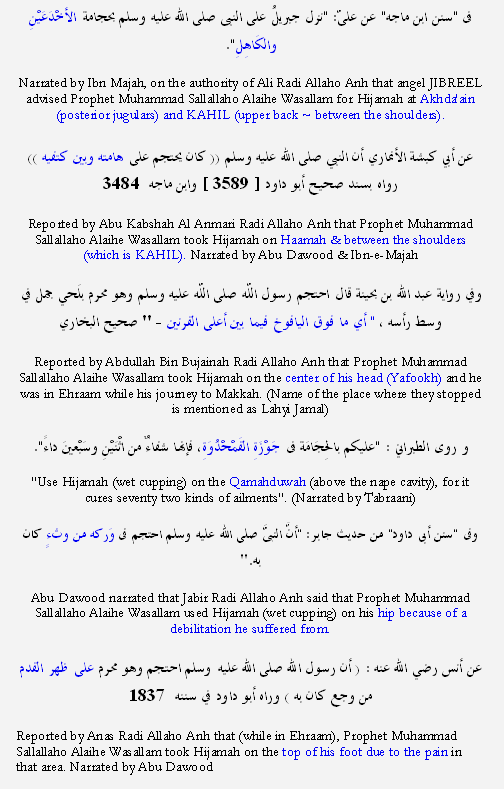
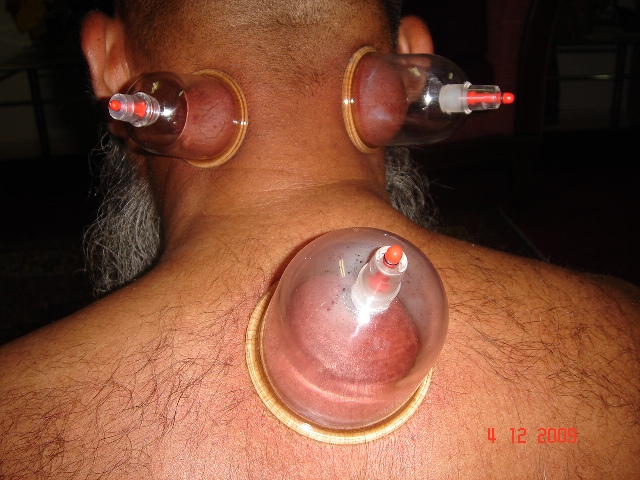
وفي "سنن ابن ماجه" عن علىّ: "نزل جبريلُ على النبى صلى الله عليه وسلم بحجامة الأخْدَعَيْنِ والكَاهِلِ".
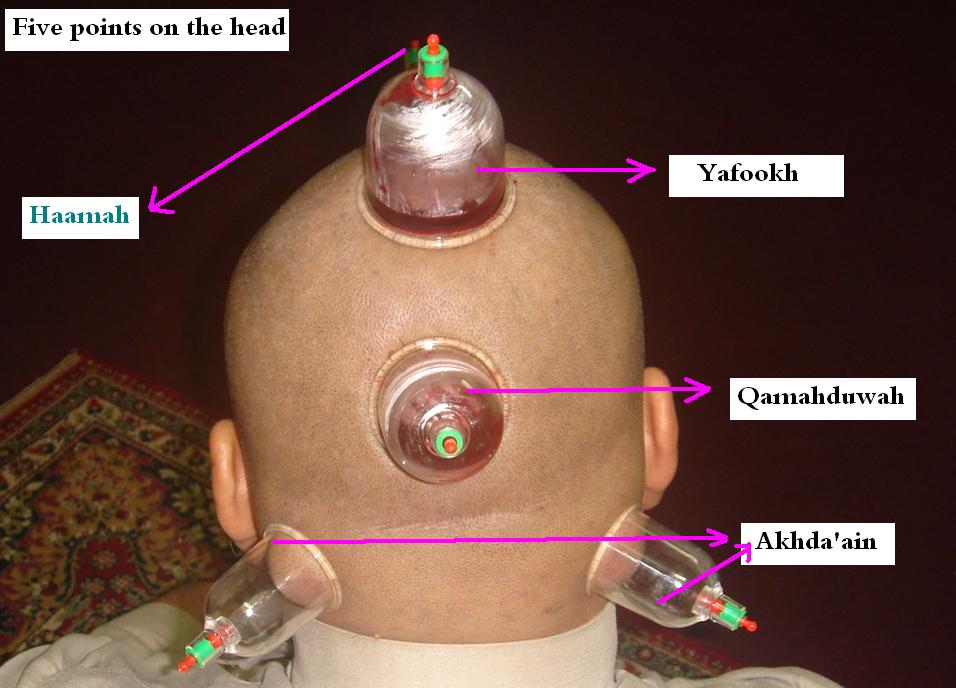
Narrated by Ibn Majah, on the authority of Ali Radi Allaho Anh that angel JIBREEL advised Prophet Muhammad Sallallaho Alaihe Wasallam for Hijamah at Akhda'ain (posterior jugulars) and KAHIL (upper back ~ between the shoulders).
عن أبي كبشة الأنماري أن النبي صلى الله عليه وسلم (كان يحتجم على هامته وبين كتفيه) رواه بسند صحيح أبو داود [ 3589 ] وابن ماجه 3484
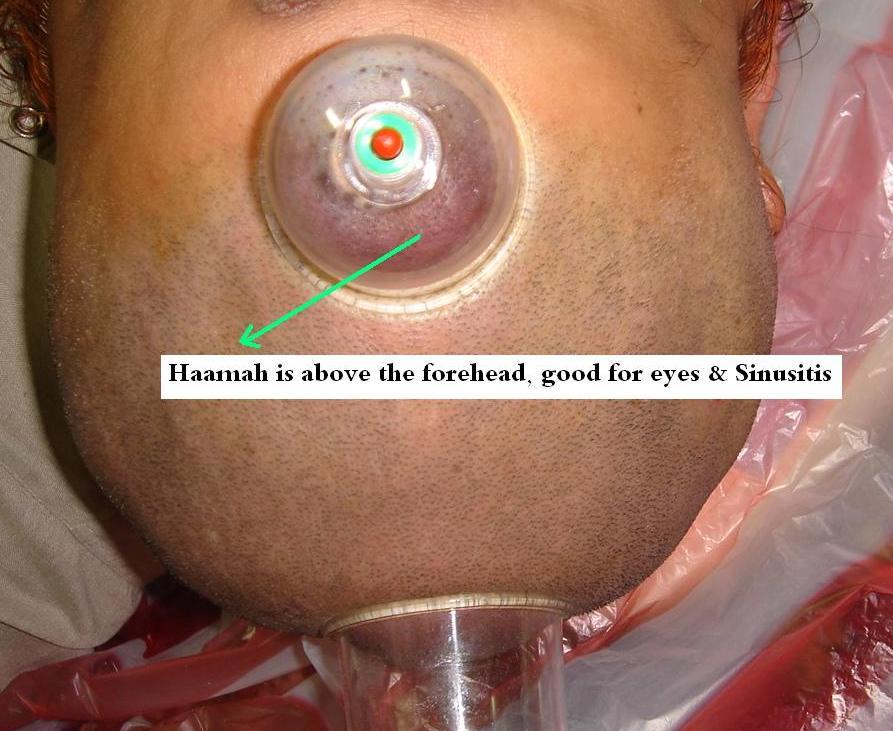
Reported by Abu Kabshah Al Anmari Radi Allaho Anh that Prophet Muhammad Sallallaho Alaihe Wasallam took Hijamah on Haamah & between the shoulders (which is KAHIL). Narrated by Abu Dawood & Ibn-e-Majah
وفي رواية عبد الله بن بحينة قال احتجم رسول اللّه صلى اللّه عليه وسلم وهو محرم بلَحي جمل في وسط رأسه ، " أي ما فوق اليافوخ فيما بين أعلى القرنين" - صحيح البخاري
Reported by Abdullah Bin Bujainah Radi Allaho Anh that Prophet Muhammad Sallallaho Alaihe Wasallam took Hijamah on the center of his head (Yafookh) and he was in Ehraam while his journey to Makkah. (Name of the place where they stopped is mentioned as Lahyi Jamal)
و روى الطبراني : "عليكم بالحِجَامَة فى جَوْزَةِ القَمْحْدُوَة، فإنها شفاءٌ من اثْنَيْنِ وسَبْعينَ داءً".
"Use Hijamah (wet cupping) on the Qamahduwah (above the nape cavity), for it cures seventy two kinds of ailments". (Narrated by Tabraani)
وفى "سنن أبى داود" من حديث جابر: "أنَّ النبىَّ صلى الله عليه وسلم احتجم فى وَركه من وثءٍ كان به ".
Abu Dawood narrated that Jabir Radi Allaho Anh said that Prophet Muhammad Sallallaho Alaihe Wasallam used Hijamah (wet cupping) on his hip because of a debilitation he suffered from.
عن أنس رضي الله عنه : ( أن رسول الله صلى الله عليه وسلم احتجم وهو محرم على ظهر القدم من وجع كان به ) وراه أبو داود في سننه 1837
Reported by Anas Radi Allaho Anh that (while in Ehraam), Prophet Muhammad Sallallaho Alaihe Wasallam took Hijamah on the top of his foot due to the pain in that area. Narrated by Abu Dawood.

Hijamah & the EVIL FORCES, The Jinn & Human Sickness
Being a Sunnah of Prophet Muhammad Sallallaho Alaihe Wasallam, it is the power of Hijamah that it crushes the spells of Sehr (Magic), Jinn, Evil Eye and مس الشيطان Muss-ul-Sheytaan (Touch of Sheytaan). And when the spell is broken, condition of the Mahjoom changes with heavy sweating, vomits, feeling thirsty, lips turning white, breath releasing a bad smell, etc.
Some people complain that relatives & friends have done Sehr on them, but almost 80 % of them are absolutely free & clean of Sehr. It is just the wrong concept among them that was induced by some Aamil (Raqi) Hazraat to whom they contacted earlier.
Our grief, worry, sadness & depression is not always due to Sehr, it is the evil of our own sins & mischief which we commit daily, by breaking the Laws of Allah & not repenting to him, not seeking His Forgiveness, staying away from Salehaat, Salaat, Quran, Zikr, etc. The evil forces & JINN (Sheytaan) can easily occupy such a weak person.
Another reason for being captured by the evil forces is the SEPTIC SUBSTANCE; you will never believe the heavy words of Ibn Al Qayyam when he wrote :
ولا سيما عند هيجان الدم، والمِرَّةِ السوداء، وعند هَيجان المنَىّ، فإنَّ الأرواح الشيطانية تتمكن مِن فعلها بصاحب هذه العوارض ما لا تتمكَّن من غيره
"Body experiences the ailments that are caused by septic substances, especially when blood, black bile or semen is irritated. Evil forces take control of the body when it experiences such emotions and ailments".
Blood will spoil if Hijamah is not taken for years, turning into Black Bile that oxidizes further to worst, & not adopting this Sunnah will definitely invite the EVIL; it is the septic blood in which Sheytaan resides. Similarly, when a man stays away from his wife, the semen will spoil, opening the door for evil forces to enter his body.
It is necessary to repeat Hijamah at least twice per year, so that you remain neat & clean by evils, furthermore, staying away from your wife is a dangerous mistake, Sheytaan will capture you very easily in this situation.
You may also read the book "The JINN & Human Sickness", it is a beautiful compilation which explains all the issues that are related to JINN & diseases.
Hijamah & Waswasah ~ Whisperings of Sheytaan
Sheytaan is the biggest enemy of human, & Waswasah (whisperings) is one of his weapons which destroys the Eemaan of a Muslim, weakens the connection with Allah, makes a Mo'min hopeless & enforces him / her to forget that Allah is The Most Merciful, Forgiver of sins.
Waswasah may also create depression & Anxiety disorders, it is against the nature of a Muslim that he / she can suffer with such kind of ailments, Allah is our Creator & He is the One Who Makes us laugh & cry, whoever tolerates the TRIALS with Sabr (patience) & Shukr (thanking Allah), he / she will gain the Kamaal (completion) of Eemaan.
Being the Sunnah of Prophet Muhammad Sallallaho Alaihe Wasallam, it is the power of Hijamah that it crushes all evils; including Waswasah. Hijamah as 5 points (Haamah, Yafookh, Qamahduwah & Akhda'ain) on the head is the most beneficial in this regard, & it brings concentration & pleasure in Salaat, recitation of Quran & Zikr.
With Waswasah & depression, your mind will be weak & you may suffer with forgetfulness, for which Frankincense is the best medicine from Tibb-e-Nabawi.
Hijamah & SPINE
Areas around the SPINE (back) are the major storage tank for septic blood, & once the back is drained with Hijamah, many problems are fixed Alhamdolillah.
The most appropriate points to drain the complete SPINE are eight, KAHIL & a point under the KAHIL, 2 points in right & left of KAHIL, 3 points on the middle back, & a point at the center of lower back, for individual cases, we cup at additional points, more guidance can be taken from Hijamah Atlas # 1, 2, 3 which are available in Downloads section of this website.
Furthermore, Hijamah at Akhda'ain (posterior jugulars) is the best medicine for cervical problems, Akhda'ain & KAHIL are the points indicated by Rooh-ul-Ameen; Angel Jibreel, it is almost a WAHEE.
Attached herewith is a Powerpoint Slide show that elaborates the spine segments & diseases that are linked to them.
Lipids, ALT/GPT with Hijamah
Lipids, ALT/GPT with Hijamah & Tibb-e-Nabawi Diet
We received an inquiry from a person (Mr. Zeeshan Ahmed Khan) living in UAE, that he suffered with high Cholesterol & a fatty liver.
We requested him to take Hijamah immediately & he contacted Bhai Hamza Ali , our SINGLE TRUST for Hijamah in U.A.E.
8 cups were applied at the back (as shown in the picture) & we insisted to drain out at least 300 ~ 350 ml of Hijamah blood.
Furthermore, the patient was guided to follow a strict Tibb-e-Nabawi diet, HENNA Water, Talbinah at breakfast, Barley Water, Barley Bread, Nabeez ~ Drink made with soaked Raisins, etc. We asked him to stop wheat & rice, animal proteins, vegetable oils, soda drinks, deep fried foods, tea, coffee, canned food and on the shelf Dairy products, he was asked to cook all of his curries in the blessed Olive Oil (Cooking / Frying in Olive Oil).
The patient sent his reports to us & Masha'Allah that after 45 days of Hijamah & Tibb-e-Nabawi diet, his Total Cholesterol dropped down by 38 %, Triglycerides surprisingly quenched down by 69 %, & ALT / GPT lowered by 54 %, Alhamdolillah.
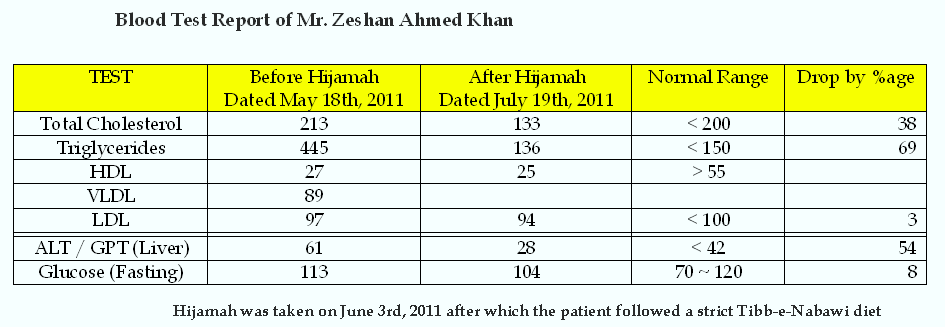
So we call it the Drastic quenching, like putting a fire torch in a bucket of ice, & if he had gone the other way with conventional medicines, their side effects could have given birth to more complications; the worst of which is Erectile Dysfunction, we call it "Extinguishing the fire with Kerosene oil".
His liver was damaged (ALT/GPT was 61), it is the miracle of Hijamah that it removes the septic blood, PLUS the extra Bile secretions, if Hijamah blood is kept for 2 hours without tilting the container, you will observe a YELLOW liquid coming on the surface, these are the un-wanted Bile secretions that float on the top (because they are lighter than the Black Bile).
Regarding his HDL, it was low even before Hijamah, due to wrong diet, his Cholesterol / Triglycerides were high & HDL was depressed, so Hijamah fixed the dangerous digits first & we told him that HDL will improve steadily within 3 ~ 5 months, we requested him to stick with the blessed olive oil, barley bread, & to take a tablespoon of both Flaxseeds + Kaddu seeds (Pumpkin seeds) in Talbinah at breakfast, furthermore, the recipe of Camel's Liver with Hump Fat taken once in 15 days, and Hais of dates, figs or Coconut with Cottage cheese & butter, to be prepared once a week.
You may realize that Hijamah alone was not enough, & we convey this message to all Hijamah clinics around the world "Try to display Tibb-e-Nabawi as a complete code of medicine, Hijamah is only the one fifth (20 %) portion of Tibb-e-Nabawi, CURE by the Prophetic medicine is a combination of (1) Healing by Belief (Yaqeen) that Allah Has Sent the disease & Allah is the HEALER, & if the healing is delayed, it is by Allah’s Wisdom & Hikmah, (2) Healing by Aa’maal-e-Saalehaat, Salaat, Sadaqah, Fast, Quran, Zikr, Duaas & Ruqya, going out in the path of Allah, Husn-e-Khulq, abstaining from sins, Istighfaar, etc.(3) Healing by the foods of Prophet Muhammad Sallallaho Alaihe Wasallam (4) Healing by the herbs of Prophet Muhammad Sallallaho Alaihe Wasallam and (5) Healing by HIJAMAH; which is Sunnah & the best kind of treatment in this world.
Details On Hijamah Vs. Blood Donation
When people talk about the health benefits of Blood donation, it is similar to Venesection (puncturing of veins) which was called Fasd in old times. You can read the article Cauterization.
The difference between Hijamah & Fasd is the blood itself, Fasd (Blood Donation) removes fresh blood from the veins; while Hijamah removes the septic blood from underneath the skin.
FASD is helpful for diseases that are cured by extracting out the fresh blood, & those ailments are very few, but Septic blood which is the root cause of many diseases is only drained out by Hijamah. Ibn Al Qayyam wrote that "Cupping extracts the septic blood more efficiently than puncturing the veins". A surprising fact is that the putrefied Hijamah blood can't be donated.
Hijamah is superior to FASD in many aspects, a comparison of Fasd & Hijamah by observation is as under.

# | Issue | Blood Donation (FASD) | Hijamah |
1 | Point of suction | Taken out from the veins | From underneath the skin |
2 | Smell | Rarely has a bad odor | Rancid & rotten with a bad smell |
3 | Color | Reddish | Reddish brown to black |
4 | Vision | Negligible effect on vision | Enhances the vision |
5 | Cholesterol | Negligible effect on Cholesterol | Reduces cholesterol, especially Triglycerides |
6 | Weakness | Might cause weakness | Induces freshness in the body |
7 | Migraine & Headache | Negligible effect on Migraine / headache | Head's Hijamah is best for Migraine & headaches |
8 | Back pain | Can't reduce your back pain | Reduces & eliminates the back pain |
9 | Cervical Spondylosis | No effect on cervical problems | At posterior jugulars is the cure for Cervical Spondylosis |
10 | Sehr, Jinn, Evil Eye | Can't break the spell of Sehr, Jinn or Evil Eye | Powerful enough to crush spells of Sehr, Jinn & Evil Eye |
Some medical experts recommend donation of blood for good health, & Prophet Muhammad Sallallaho Alaihe Wasallam recommended Hijamah.
