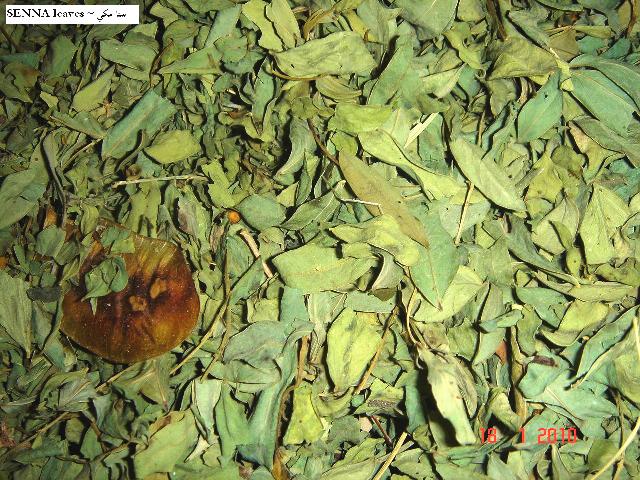
Senna & Sanoot
Tirmizi and Ibn Majah narrated that the Messenger of Allah asked Asma Bint Umais Radi Allaho Anha, "How do you deal with constipation? She said, by using Shubrum (Euphorbia). Prophet Muhammad Sallallaho Alaihe Wasallam said, it is hot and a strong laxative, she then said, in addition I use Senna and the Prophet replied, if there is a cure that prevents death, it would be senna".
Furthermore, Ibn Majah narrated in his Sunan, in Kitaab Al-Tibb (the Book of Medicine) that Ibraaheem ibn Abi ' Ablah said: I heard Abu Ubayy ibn Umm Haram say that he heard the Messenger of Allah say: "You should use Senna and Sanoot, for in them there is a healing for every disease except Al-Saam". It was said: O Messenger of Allah, "What is Al-Saam?” He said, "Death". (Inb Maajah, Kitaab Al-Tibb, Hadeeth no. 3457).
Prophet Muhammad Sallallaho Alaihe Wasallam asked the woman about what she uses to treat constipation, meaning what cure she uses to help soften the stool, so that the body is able to get rid of its harmful waste.
It was narrated that Ibn 'Abbaas (R) said that the Messenger of Allah (SWT) said:
"The best medicines which you use are those which are administered through the side of the mouth, nose drops, cupping and laxatives". (narrated and classed as Hasan by Al-Tirmidhi; narrated and classed as saheeh by Al-Hakim and by Na'eem in Al-Tibb Al-Nabwi).
Administering medication through the side of the mouth (Ladood): this means inserting the medication with the finger. The Arabic word Ladood comes from the phrase Ladeed Al-Waadi (the side of the valley). Nose drops refers to medication that is placed in the nose or is given by means of inhaling through the mouth. Laxatives are medicines given to defecate.
It is narrated from Asma' bint 'Umays that the Messanger of Allah (SWT) entered upon her one day and she had some spurge which she was grinding. He (SWS) said:
"What are you going to make with that?"
She said: We drink it. He said: "If anything were to ward off death or be of benefit against it, it would be senna". (Mustadrak Al-Haakim from the Hadeeth of 'Umar ibn Al-Khattab). Al-Haakim said: This Hadeeth has a Saheeh Isnaad and Al-Dhahabi agreed with him.
It was narrated from Asma'bint 'Umays that the Messenger og Allah (SWS) asked her:
"What do you use as a laxative?"
She said: "Spurge". He (SWS) said: "Hot, hot".
She said: Then I used senna as a laxative and the prophet (SWS) said:
"If there were anything in which there is a cure for death, it would be senna". (Al-Tirmidhi, 6/254, 256.
In another narration of the Hadith, Prophet Muhammad Sallallaho Alaihe Wasallam asked Asma about what she uses to cure constipation, and she mentioned the Shubrum (Euphorbia), which is the bark of the root of Euphorbia tree and which is dry and hot in the fourth degree. The best type of Shubrum is the one that is reddish in color, which is soft and feels like wrapped skin.
Shubrum is among the medications that doctors do not advise people to use because it is a very strong laxative. In the Hadith, our beloved Prophet described Shubrum as being hot and a strong laxative.
Senna is a plant that grows in HIJAZ (Western Arabia) and the best kind of it grows in Makkah, Senna is hot and dry in the first degree and it is a good, mild medication that does not cause any side effects and is regarded as a gentle stool softener and a effective laxative. It works directly on the colon. One of the features of Senna is that it expels bile, black bile ailments, phelgm and strengthens the heart. Senna is useful at working against depressing thoughts, cracks in the feet, tension in the muscles, the spread of hair, scabies, itching, melancholic obsession and corporal incisions, relaxes the muscles and improves the hair. It helps against lice, headache, mange, pustules, rashes and epilepsy. It is better to cook Senna as a whole and drink three measures of its soup than cooking it crushed. In addition, it is better to cook the Senna mixed with violet flowers and red raisins, after removing the seeds. If it is cooked in olive oil and drunk it expels putrid matter. It is also effective against pain in the back and hips. It is also useful in the case of chronic headaches and epilepsy; it gets rid of haemorrhoids; it is useful in the case of constipation as a stool softener and laxative. There is hardly any stool softener or laxative in the pharmacy that does not contain senna. Dr. Muhhammad ' Ali Al-Baar has written a paper on senna and its virtue according to the Sunnah, he spoke a great deal about its medicinal benifits. Amongst other things he mentioned some of the above.
Al-Razi said, Senna and fumitory help extract mature humors (bodily wastes) and helps against leprosy and rashes, when one takes four to seven measures of each remedy.
According to Ibn Al-Qayyim, other than being a laxative, senna relaxes the muscle and improves the hair; it also helps against lice, headache, rash and epilepsy. Senna can be used for the hair in the same way that Henna is applied. The difference is Senna does not colour the hair like Henna. It makes the hair thick and glossy and improves the health of the scalp.
Today the leaves and pods of the Senna plant are important ingredients of laxatives sold in most pharmacies. It is a recognised cure for constipation which begins to work 10-12 hours after ingestion. It detoxes the body and cleanses the colon.
Sihab Al-Badry Yassin a researcher in Egypt compiled a chemical analysis proving the advantages of senna. In it he shows how senna cured a patient who had bacteria in the stomach that was preventing iron absorption in his body. He was treated with cupping and Senna as a detox to cleanse his stomach and colon. For further reading please refer to his book “Medicating with Senna, A prophetic way of life.”
Application
For constipation - Boil a desert spoonful of Senna leaves with two to three glasses of water and brew for about 10 to 15 minutes or until it is reduced by half. Strain the leaves and drink the liquid before going to sleep, or in the morning on empty stomache. You Can do this for five days in a row.
For general health - Same method as above to be taken once a month.
For conditioning the hair – mix some Senna leaf powder with warm water until it becomes a paste. Apply the paste to the hair and leave in for about 10 to 15 minutes before washing off.
Constituents
• Flavanoids
• Mucilage
• Antraquinones (Sennosides)
As for Sanoot (cumin), there is a difference of opinion concerning its nature. Umar bin Bakr As-Saksaki said that Sonoot is either honey or butter extract. Another opinion suggests that Sonoot is a seed that resembles the cumin, as Ibn Al-Arabi has asserted. The fourth and filth opinions suggest that Sonoot is the Persian cumin or fennel, according to Abu Hanifah Al Daynoori. The sixth opinion suggests that it is the Shibitt(DILL SEEDS), and seventh opinion suggests that it is the dates, according to Abu Bakr bin As-Sunni. The eight opinion suggests that it is honey that exists in butter-skin. Some doctors stated that the last meaning is the most probable. In this case, Sonoot is prepared by blending Senna powder with some honey mixed in Ghee, as this is better than taking Senna alone. Then, one licks the mixture that contains Senna, because of the honey & butter which assist further the laxative features of Senna, Allah Knows the Best.